A product page sells a garment the buyer cannot touch. They cannot feel the weight of the fabric, stretch the hem, or check how the seams are finished. Everything they need to trust the purchase has to live on the screen. And yet the one piece of information that tells a shopper how to keep that garment alive — the care instructions — is almost always the most neglected thing on the page.
Usually it shows up as a grey line of text near the bottom: “Machine wash cold, tumble dry low, do not bleach, iron on low heat, do not dry clean.” On a phone, that line gets skipped. The shopper has already decided.
This guide covers the system behind those instructions — ISO 3758 — what each symbol actually means, and how to put care information on your Shopify product pages in a way people will actually look at. It is written for fashion merchants, not compliance officers, so the focus is on what helps you sell and what reduces the “it got ruined in the wash” complaints that quietly drive returns.
What ISO 3758 actually is
ISO 3758 is the international standard that defines the care symbols you see on clothing labels. Its full title is “Textiles — care labelling code using symbols.” The current version is ISO 3758:2023, the fourth edition, published in December 2023, which replaced the 2012 edition after a technical revision.
The standard does one useful thing: it turns washing instructions into a language of symbols that works regardless of what language the shopper speaks. A buyer in Ahmedabad, London, or Toronto reads the same washtub icon the same way. For anyone selling across borders, that is the whole point.
Every symbol in the system communicates the most severe treatment that will not damage the garment. If a label shows a washtub with “30” inside it, that means 30 degrees is the maximum safe wash temperature. Cooler is always fine. And if a care family is left off the label entirely, every process in that family is considered allowable.
The five symbol families
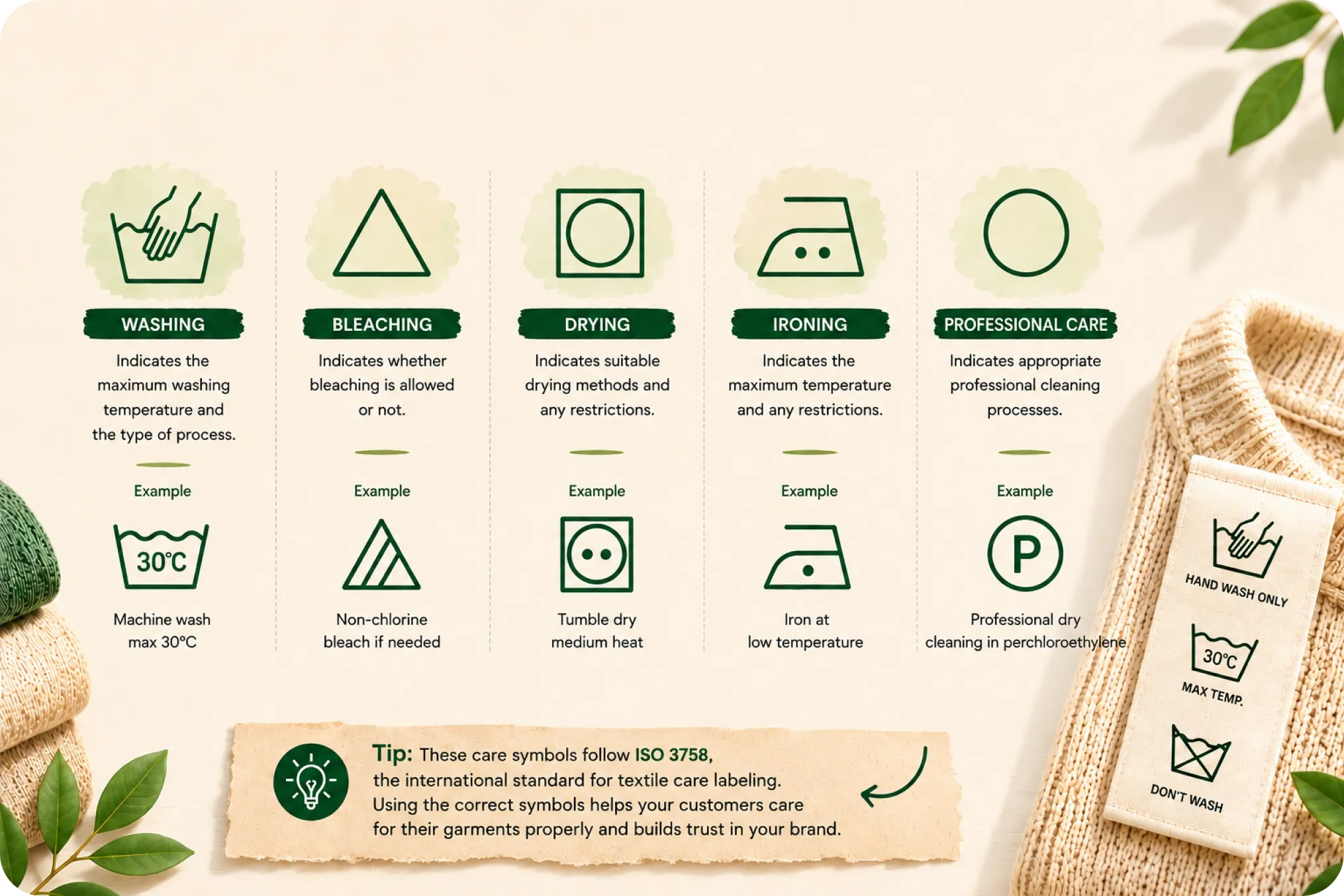
ISO 3758 organizes all care information into five groups, always presented in the same fixed order. Once you know the five shapes, you can read any care label in the world.
- Washing — the washtub. This covers machine and hand washing. A number inside the tub gives the maximum temperature. A hand in the tub means hand wash only. Bars beneath the tub signal how gentle the wash cycle needs to be: one bar for mild, two for very gentle. A cross through the tub means do not wash at all. The 2023 revision added a new symbol for hand washing at ambient temperature.
- Bleaching — the triangle. A plain triangle means any bleach is fine. A triangle with two diagonal lines means only non-chlorine, oxygen-based bleach. A crossed-out triangle means do not bleach.
- Drying — the square. A circle inside the square means tumble drying is allowed, with dots for the heat level. Lines inside the square describe natural drying: a horizontal line for dry flat, a vertical line for line dry, a diagonal line in the corner for dry in shade. For delicate and natural fabrics, the drying symbol matters more than people expect.
- Ironing — the iron. Dots inside the iron icon set the maximum temperature: one dot for low, two for medium, three for high. A crossed-out iron means do not iron, and an iron with a crossed-out steam symbol means no steam.
- Professional care — the circle. Letters inside the circle (P, F, or W) tell a professional cleaner which solvents or wet-cleaning processes are safe. For shoppers, the practical signal is simpler: a circle usually means “take this to a professional,” and a crossed-out circle means do not dry clean.
That is the entire system. Five shapes, read left to right, each one telling the buyer how much the garment can take.
ISO 3758 versus ASTM D5489
If you sell into North America, you will run into a second standard. The United States and Canada use ASTM D5489, maintained by ASTM International. The good news is that the two systems share the same five families in the same order, and ASTM was deliberately revised to align more closely with ISO.
The differences are in the details. The most visible one is natural drying. ISO uses lines inside the square, while ASTM has historically drawn a square with a curved line across the top to represent a clothesline. The bleaching symbol also looks slightly different between the two. For most fashion merchants the ISO symbols are the safer default, since they are recognized internationally, but if your primary market is the US it is worth knowing both exist.
A licensing nuance most guides skip
Here is something the typical “laundry symbols explained” article never mentions. The five core care symbols are registered trademarks, co-owned by GINETEX, the international body for textile care labelling, and its French member COFREET. They are registered in most countries, including India. Strictly speaking, commercial use of these symbols requires a license.
In practice, enforcement against a small online store showing care icons on its product pages appears to be uncommon. But the obligation exists, and it is worth being aware of. If you would rather not deal with the question at all, a clean, visually distinct icon set that conveys the same meaning without copying the trademarked marks sidesteps it entirely. This is not legal advice. If you are unsure, GINETEX or your national textile body can tell you where you stand.
Why text-based care instructions fail online
Now to the part that affects your conversion rate. The problem with the grey care-instruction line is not the information. It is the format.
Online shoppers do not read. They scan. Nielsen Norman Group’s eye-tracking research established the F-shaped reading pattern years ago: people fixate on the top and left of a page and skip dense blocks of text. In one widely cited analysis, NN/g concluded that on an average web page users have time to read at most about 28 percent of the words, and 20 percent is more likely.
Stack that against how fast purchase decisions happen. Nielsen reported that the average consumer spends roughly 19 seconds making a brand purchase decision online, and that the majority spend less than 10 seconds. A care string like “Machine wash cold, tumble dry low, do not bleach, iron low, do not dry clean” is exactly the kind of dense, low-priority text that loses in a 19-second window.
Symbols win here for a simple reason: they are scannable at a glance and they do not depend on language. There is a popular myth that the brain processes images 60,000 times faster than text. That number is made up and has been debunked, so ignore it. But there is real, peer-reviewed evidence in the right direction. A study published by the ACM in 2023 found that in glanceable, multitasking conditions, a pictogram format had a higher recognition rate than text when the icon could stand in for several words. The effect is strongest when the icon is already familiar, which is precisely why a standardized system like ISO 3758 is valuable: shoppers have seen a washtub before.
This is the gap that matters. Baymard Institute found that 90 percent of apparel sites fail to give shoppers enough information to properly assess a product. Care information is one of the first things to fall through that crack.
How to add care instructions on Shopify
There are three honest ways to do this, from simplest to best.
Option one: text in the product description. You type the care instructions into the description. It works, it costs nothing, and it is also the version most likely to be skipped. Fine as a stopgap, weak as a strategy.
Option two: Shopify’s native Care guide metafield. Shopify supports this out of the box and it is the method Shopify itself recommends. The path is: Settings, then Custom data, then Products, then add the standard “Care guide” metafield definition. Enter the care values for each product. Then open your theme in the editor, add a “Collapsible row” block, and connect it to the Care guide metafield using the dynamic-source icon. This is structured and tidy, and on an Online Store 2.0 theme like Dawn it slots into the product page cleanly.
The catch is that it renders as text. You get a neat collapsible row that says “Machine wash cold,” not the visual washtub icon. It is better than burying care in the description, but it does not solve the scanning problem.
Option three: render the symbols visually. To actually show the ISO 3758 icons, mapped to each product, you need something that reads your care data and draws the symbols on the page. There is surprisingly little here. The one dedicated app on the Shopify App Store, Architechpro’s Laundry Symbols Clothing Care at $2.99 a month, builds a single static reference page explaining what symbols mean. It does not render per-product symbols tied to each item’s actual care needs, and adoption is negligible. For a category as universal as garment care, that is a thin field.
This is the gap StyleImprint was built to close. It reads your existing product data, maps each garment to the right care preset, and renders the ISO 3758 icons as visual blocks on the product page, alongside fabric composition, fit, and model measurements. Care icons are included even on the free plan, and each of the 57 garment templates comes pre-mapped to the care presets that fit it, so a silk saree and a pair of jeans get the right guidance without you setting it up by hand.
Care for Indian ethnic wear, where generic instructions break down
If you sell sarees, lehengas, or anything with zari or brocade, the standard “machine wash cold” line is not just skippable, it is wrong. This is where richer care information earns its place.
Silk sarees, especially Kanchipuram and Banarasi, are dry-clean only, should never go in a machine, and need to dry in shade because direct sunlight fades the color and weakens the fibre. They should be stored wrapped in muslin or pure cotton, never plastic, which traps moisture and invites mildew, and refolded every few months so permanent crease lines do not set.
Zari work, the metallic thread, tarnishes and blackens when exposed to moisture and air. It needs a dry storage environment, should be wrapped with the zari folded inward, and must never be wrung or twisted. Brocade should be wrapped in soft, breathable fabric and stored flat, not hung, because its weight will stretch and tear it over time.
A buyer spending a significant amount on a silk saree wants to see that you know this. Showing it on the product page does two things at once: it builds the trust that closes a high-value sale, and it heads off the “my saree was ruined” message that turns into a return or a refund request. No generic care app handles this. A template built for ethnic wear does.
Where this is heading: the EU Digital Product Passport
One more reason to structure your care data now rather than later. The European Union is rolling out the Digital Product Passport for textiles under its Ecodesign regulation. The delegated act that spells out the exact requirements is expected around 2027, with compliance following roughly 12 to 18 months after, so realistically 2028 or later. Dates in this area have slipped before, so treat them as direction, not deadline.
The DPP will require structured, machine-readable product data, and care and maintenance information is widely expected to be part of it. ISO 3758 symbol data is the natural way to express that: standardized, language-independent, and already digital. If you capture your care data as structured fields today, you are positioned to map it into a passport later instead of rebuilding from scratch. Selling into the EU makes this close to inevitable; even if you do not, structured care data costs you nothing and leaves you ready.
The short version
Care instructions are not a legal footnote to bury at the bottom of a description. On a product page they are a trust signal and a scanning opportunity, and right now most stores waste them. ISO 3758 gives you a clean, universal language of five symbol families. Showing those symbols visually, instead of as a grey text line, fits how shoppers actually read, helps you sell higher-value pieces, and keeps you ready for what is coming in textile regulation. The information is already on your hangtags. The opportunity is putting it on the page in a form people will look at.
Frequently Asked Questions
What do ISO 3758 care symbols mean?
ISO 3758 organizes all garment care into five symbol families, always shown in the same order: a washtub (washing), a triangle (bleaching), a square (drying), an iron (ironing), and a circle (professional dry or wet cleaning). A symbol shown without a cross indicates the most severe treatment the garment can safely take, so any gentler method is also allowed. A cross through any symbol means do not use that process.
How do I add care instructions to a Shopify product page?
Shopify supports care information natively. Go to Settings, then Custom data, then Products, add the standard Care guide metafield definition, and enter values per product. Then in your theme editor add a Collapsible row block and connect it to the Care guide metafield using the dynamic source icon. This renders as plain text. To show visual ISO 3758 icons instead of a text string, you need an app that maps care data to symbols and renders them on the product page.
Is ISO 3758 the same as ASTM D5489?
They are closely related but not identical. ISO 3758 is the international standard used across the EU and much of the world. ASTM D5489 is the North American standard. Both use the same five families in the same order, and ASTM was revised to align more closely with ISO, but they differ in some symbols, most notably the natural-drying symbols and the bleaching symbol.
Do I need a license to use laundry care symbols?
The five core care symbols are registered trademarks co-owned by GINETEX and COFREET, and strict commercial use generally requires a license. Enforcement against small online stores displaying symbols on product pages appears uncommon in practice, but the obligation exists. Merchants who want to avoid the question entirely can use a visually distinct, non-trademarked icon set. This is not legal advice; check with GINETEX or your national member if you are unsure.