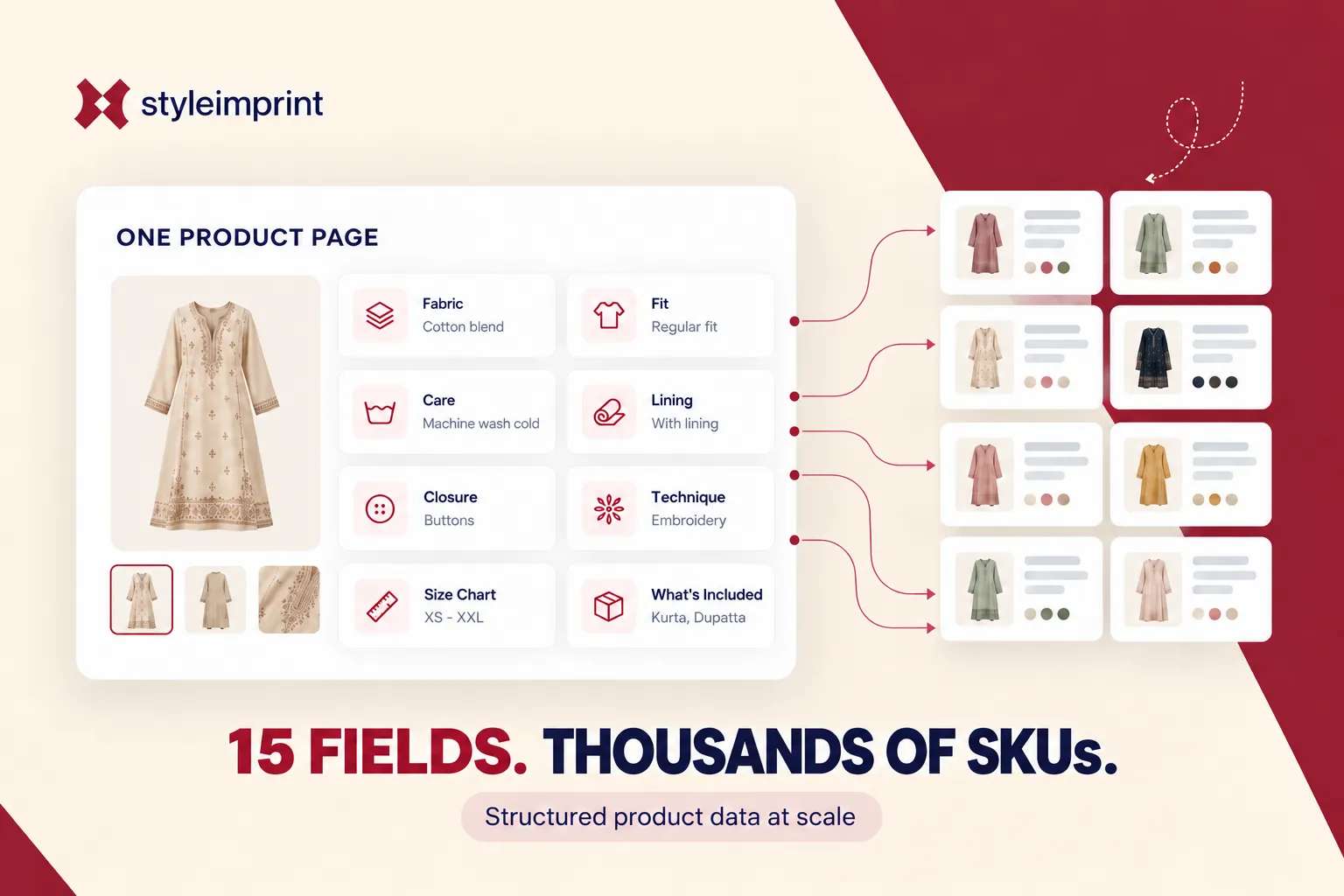
A good fashion product page looks effortless. What is included, the fabric, the construction, the closure, the lining, the care, a detailed size chart: it all sits in one clean, scannable block, and shoppers read it as confidence.
The merchant sees something else. Fifteen fields per SKU, every one of them collected, interpreted, entered, formatted and reviewed. One page is an afternoon. A catalogue is a different job entirely, and it is the part almost nobody plans for.
One product page, fifteen fields
During a recent review of a Shopify fashion store, one product page stood out. It did not rely only on attractive photographs and a long product description. It clearly showed what was included in the outfit, its fabric, garment construction, closures, lining, border, technique, garment length and a detailed size chart.
As a shopper, the clarity was welcome. As someone building tools for fashion merchants, the reaction was different: how much work did it take to organise this information across the full catalogue?
That question matters because creating one detailed product page is manageable. Maintaining the same depth and consistency across hundreds of products is a very different operational problem, and it is the version of the Baymard 90 percent that no shopper ever sees.
One garment can require many separate details
A fashion product is rarely described by size and colour alone. For an ethnic-wear set, a shopper may need to know:
- Which garments are included
- The fabric used for each component
- Whether the blouse or top is stitched
- Sleeve and neckline details
- Skirt or garment length
- Lining and padding
- Closure type
- Border or construction details
- Embroidery or production technique
- Care instructions
- Chest, waist, hip, shoulder and armhole measurements
These are not decorative extras. They answer practical questions a shopper cannot resolve from photographs alone, which is the same argument behind the care and fabric guides: the facts belong in structured fields, not in a paragraph.
The reviewed page presented many of these details in clean visual cards. It was easy to scan and far more useful than hiding everything inside one long description. But every visible card represents data that someone had to collect, interpret, enter, format and review.
The problem appears when the catalogue grows
Imagine a store with 300 products and 12 structured details for each one. That is 3,600 individual pieces of product information before you count size charts, variants or future updates.
The difficulty is not typing the information once. The team also has to keep it consistent. One person writes “side zip”, another enters “zip closure”, and a third leaves the field inside the product description. Fabric names follow different formats. Care instructions appear on some products and not others. A product copied from an older listing retains details that no longer apply.
Over time, a well-designed product page becomes a catalogue maintenance system. That is the hidden work shoppers never see.
Why copying and pasting is not a reliable system
The usual approach is to build one good product page and duplicate it for the next product. It feels efficient at first, and it creates three risks.
1. Old details remain on new products
When a listing is duplicated, a closure, lining or care instruction from the previous garment can easily remain unchanged.
2. Similar information is written differently
The same fabric or fit gets described in several ways, which makes the catalogue inconsistent and harder to manage. It is the drift that shows up most clearly on fabric composition, where a field living in prose can never be compared across products.
3. Missing fields are difficult to find
A team may know that some products are incomplete without knowing which products are missing fabric, care, fit or model information. The larger the catalogue becomes, the less practical it is to open every product and check each field by hand.
Most stores already have part of the information
The good news is that fashion merchants are usually not starting from zero. Useful details are already present in product titles, descriptions, tags, product types, existing metafields, size-chart pages and supplier or production sheets.
The problem is that the information is scattered and written for different purposes. A description mentions the fabric in a sentence. A tag identifies the fit. Care instructions sit at the bottom of the page. The facts exist, but nothing organises them into a structure that can be displayed and managed across the catalogue. That starting point is exactly what auto-map was built for.
This is where assisted mapping becomes useful
StyleImprint was designed for this catalogue problem. Its Auto-Map feature reads existing Shopify product information and proposes values for fields such as fabric, fit, care, model and sizing details. When it is unsure, it flags the field for human review rather than publishing a guess.
This changes the merchant’s work from:
Open every product and enter every detail manually.
to:
Review what was found, confirm uncertain fields and complete what is genuinely missing.
The difference becomes meaningful when a store has hundreds of products. Auto-mapping will not find information that has never been recorded, and it should not replace human judgement on an ambiguous garment detail. Its value is in reducing repetitive work and showing the team where review is still needed.
Mass editing handles the remaining gaps
Some product information will always need manual input. A new collection may introduce a different construction technique. Several garments may share the same lining or care instructions. A production team may send updated details after the products already exist in Shopify.
Opening every product separately is unnecessary in these cases. A mass-editing view lets the merchant work across multiple products in one place, compare fields and complete repeated details faster. More importantly, it makes inconsistency visible.
The goal is not to remove the merchant from the process. It is to give the merchant a better place to review and manage the work.
A useful fashion product page needs two systems
The page reviewed at the start demonstrated what shoppers should receive: clear, visual, garment-specific information. Producing that experience reliably takes two separate capabilities.
- A presentation system that makes product details easy for shoppers to scan.
- A catalogue system that helps the team collect, review and maintain those details across every relevant product.
Most stores solve the first part with custom design work. The second is where the ongoing time and the inconsistency usually stay. StyleImprint connects both sides: it organises fashion-specific product information and displays the confirmed details as a visual block on the product page, with a garment template deciding which fields matter for which product type.
The question to ask about your own catalogue
Open five products from the same collection and compare them. Do they all show the same type of information? Is fabric presented consistently? Can shoppers understand what is included, how the garment fits and how it should be cared for? Can your team quickly identify which products still have missing details?
If answering those questions means opening products one at a time, you may not have a product-page problem. You may have a catalogue operations problem. You can see how much of your own catalogue fills itself in on the free plan before you decide which one it is.
The short version
One detailed fashion product page is a shopfront; hundreds of them are an operations system. Every visual card a shopper sees, fabric, fit, construction, care, model, sizing, is a field somebody has to collect, enter consistently and keep current as the catalogue grows. Copy and paste does not hold up, because duplicated listings carry old details forward and the same facts get written a different way on every product. The workable answer is to start from the information already in your titles, descriptions, tags and metafields, let assisted mapping propose the structured values and flag what it cannot confirm, then review the gaps across many products at once instead of one at a time. Presentation is what the shopper sees. The catalogue system behind it is what makes the presentation true.
Frequently Asked Questions
How many product details does one fashion product page need?
A detailed ethnic-wear page can carry a dozen or more: which garments are included, the fabric of each component, whether the top is stitched, sleeve and neckline detail, garment length, lining and padding, closure type, border or construction detail, embroidery technique, care instructions and a full measurement chart. Each one answers a question a shopper cannot resolve from a photograph, which is why every one of them ends up as a field somebody has to fill.
Why is copying and pasting a product page a problem?
Duplicating a listing carries the previous garment's details with it, a closure, lining or care line that no longer applies, and it lets the same fabric or fit be described several different ways across the catalogue. It also hides gaps: nothing on the page tells the team which products are missing fabric, care or model information. The catalogue drifts out of consistency in ways that are hard to see and harder to audit.
Does StyleImprint find product information that is missing?
No. Auto-map reads the product data you already have, titles, descriptions, tags, product type and existing metafields, and proposes structured values from it. Where a fact has never been recorded it is flagged for review instead of guessed. The remaining gaps are then worked through in the Mass Edit grid, where the same detail can be completed across many products at once.
How is a catalogue operations problem different from a product page problem?
A product page problem is about what one page shows. A catalogue operations problem is about keeping that information complete and consistent across hundreds of SKUs. Most stores solve the first part with custom design work; the second is where the repetitive entry, the inconsistencies and the missing fields quietly accumulate. If you cannot tell which products are incomplete without opening them one at a time, it is the second problem.